
Coffee County Court Records After Arrest
A Coffee County jail arrest starts at the Coffee County Pre-Trial Detention Center in Douglas. The court record is a separate public record path. Jail or app data may show arrest charges, warrant codes, bond status, and whether a person is still in custody. Court records show the formal criminal case as it moves through the correct Coffee County court, with the filed charge, case number, docket entries, hearings, and final action when one exists.
The split matters because an arrest charge is not always the charge that appears in court. The Waycross Judicial Circuit District Attorney, led by George E. Barnhill, decides what formal charges to file, amend, reduce, dismiss, or present to a grand jury when the case calls for it. For booking and custody detail, use the Coffee County jail inmate records page. For booking-photo questions, use the Coffee County jail mugshots page. The court record after arrest is the case file, not a mugshot gallery.
The Georgia Courts eAccess directory is the official statewide place to start when looking for court access routes. The screenshot below is from that official directory, which routes users to court-record access points rather than serving as a single Coffee County case database.
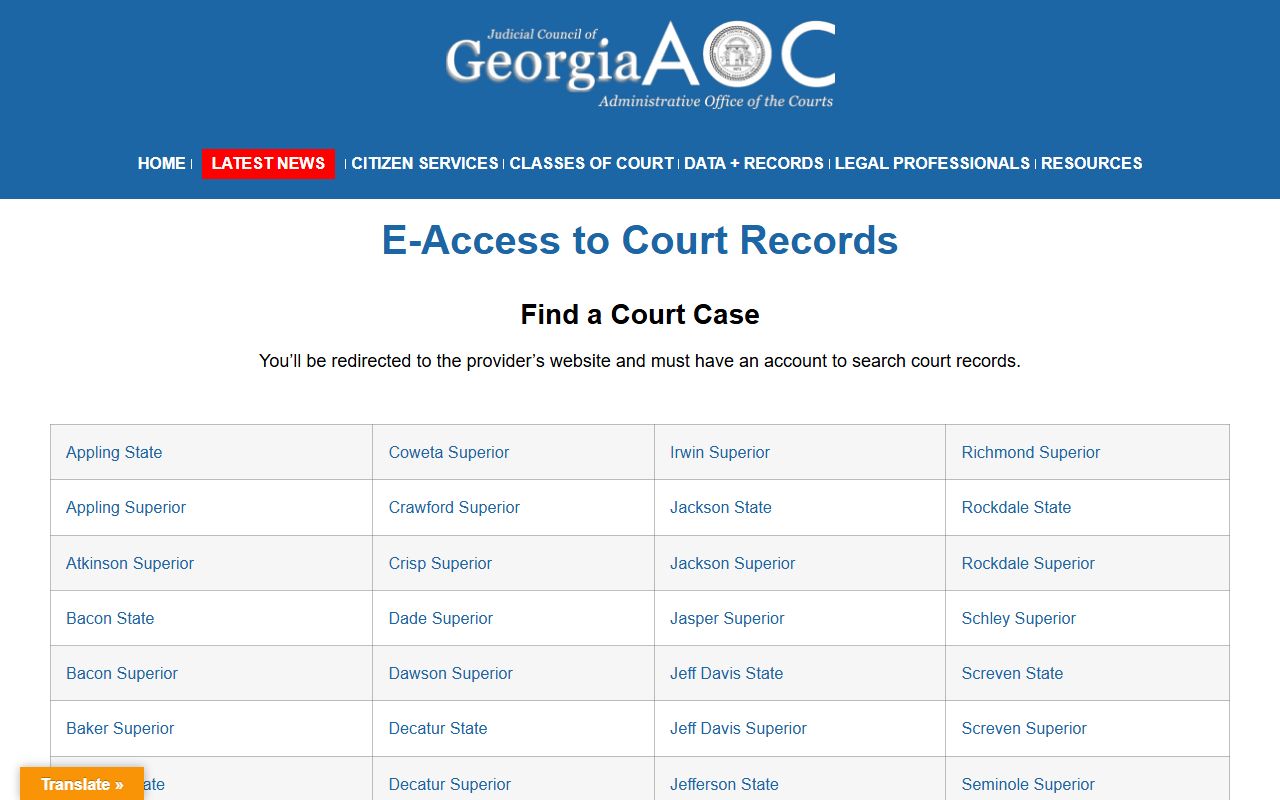
Use the directory to identify the court access channel, then compare any court-filed charge against the jail arrest entry before treating the two records as the same thing.
Find Coffee County Court Records
For Coffee County court records after an arrest, start with the facts that reduce false matches: full name, booking date, arresting agency, visible charge text, warrant code, and any case number on a citation, bond paper, or notice. If the sheriff app gives only a jail record, treat it as a pointer. The court system may use a different charge label once the prosecutor files the case.
- Check the jail or app record first for the person's full name, booking date, visible charges, and custody status.
- Use the Georgia Courts eAccess directory or PeachCourt to look for Coffee County court access.
- Search by defendant name when the portal permits it. Use a case number when one is available, because names can match.
- Open the docket or case summary and read each charge, case status, hearing entry, and bond entry separately.
- For older, sealed, missing, or non-imaged documents, contact the clerk or the court that holds the file.
PeachCourt is a statewide Georgia portal used by participating courts for electronic filing and access. The research did not confirm a uniform free document view for every Coffee County criminal file, so document access may depend on the selected court, account rules, and any lawful fee. Statewide criminal-history requests through Georgia.gov or GBI are a different channel. They can report Georgia criminal-history data, but they do not replace a Coffee County court docket or clerk copy.
| Field | Type | Required | Notes |
|---|---|---|---|
| Court or county selection | Dropdown or directory route | Varies | Georgia eAccess routes users by court; PeachCourt access varies by court. |
| Party or defendant name | Text | Varies | Use full legal name from the jail or court paper when possible. |
| Case number | Text | No, but best | Reduces false matches when copied from a notice, warrant, citation, or clerk record. |
| Date range | Date | Varies | Some systems allow filing or hearing ranges, but this is not uniform statewide. |
| Document access | Portal, account, or payment | Varies | Some images or copies may require login, clerk handling, or lawful fees. |
The PeachCourt portal screenshot below fits this search step because it is one of the Georgia court access channels documented for Coffee County court-record research.

If PeachCourt does not show the needed file, the next step is not to assume the case is gone. Contact the relevant Coffee County clerk or court for the record holder's process.
Coffee County Arrest Charges Filed
After a Coffee County arrest, the jail booking reflects custody intake. The formal court record begins when a charging document is filed or when a case is otherwise opened in the proper court. First appearance and bond matters may start in Magistrate Court, while felony prosecution commonly moves through Superior Court. Some misdemeanors, traffic matters, ordinance cases, or probate-linked matters may route elsewhere depending on the charge and stage.
Georgia terminology can vary by court and case type. The core point is the same: the document filed in court controls the formal charge record. A booking label may be broad, short, or based on a warrant. A prosecutor-filed accusation, information, or indictment may be more precise, may drop a count, or may add a count supported by the investigation.
| Charging Document | Filed By | Common Use | What to Check |
|---|---|---|---|
| Complaint or accusation | Officer, court, or prosecutor depending on stage | Misdemeanor or lower-court proceedings | Charge text, statute code, filing date, and next court date. |
| Information or accusation | Prosecutor | Prosecutor-filed criminal charges where allowed | Whether it matches, amends, or replaces the jail arrest charge. |
| Indictment | Grand jury | Serious felony prosecution | Counts, defendants, charge level, and arraignment or hearing entries. |
The official Coffee County Magistrate Court page is useful for local first-appearance and magistrate-court context. It is not a substitute for checking the court file or the clerk when a filed document is missing online.
Waycross DA Court Records
The prosecutor's role is central to court records after a jail arrest in Coffee County. The Prosecuting Attorneys' Council of Georgia identifies Coffee County as part of the Waycross Judicial Circuit, with George E. Barnhill serving as District Attorney. The DA does not run the jail roster. The office decides what charges to pursue after law enforcement makes an arrest and the jail books the person.
That decision can change the look of the court record. A charge can be amended, reduced, dismissed, or presented to a grand jury. For felonies, indictment may be part of the path. For misdemeanors, a complaint or accusation may be enough depending on the charge and court. Victims or family members who need custody alerts can pair the prosecutor and clerk route with Georgia VINELink, which handles custody notifications but does not replace court records.
The Waycross Judicial Circuit District Attorney profile is the official prosecutor directory source used to identify the DA serving Coffee County.

Use the DA profile for prosecutor identity. Use Georgia eAccess, PeachCourt, or the proper clerk for the filed case record.
Coffee County Charge Status
Charge status terms show where a Coffee County court record stands after an arrest. They should be read by count, not just by case. One charge in the same case may be pending while another is dismissed, amended, or resolved by plea. A jail release also does not end the case unless the court record shows dismissal, nolle prosequi, acquittal, plea, sentence, or another final action.
| Status | Plain Meaning | Reader Check |
|---|---|---|
| Pending | The charge remains open in court. | Check the next hearing, bond terms, and whether the defendant is still in custody. |
| Amended or reduced | The filed charge changed from the original arrest or earlier court entry. | Compare the newest filed charge to the jail booking and prior docket entries. |
| Dismissed | The charge ended without a conviction on that count. | Confirm whether other counts in the same case remain active. |
| Nolle prosequi | The prosecutor declined to continue that charge. | Read the order or docket entry before assuming all related matters are closed. |
| Conviction | A guilty plea or finding of guilt was entered. | Review sentence, probation, custody transfer, and any appeal or post-case entries. |
Note: A Coffee County jail release can happen while court records after the arrest still show a pending case.
Bond After Coffee County Arrest
Bond is part of the arrest-to-court path, not proof that a charge is over. Georgia law permits several release types, including cash, surety, property, and recognizance-style release. Some charges or holds may remain no-bond until a judge acts. Coffee County-specific payment methods, counter hours, and fee details were not published in the official pages reviewed, so call the Coffee County Pre-Trial Detention Center at 912-384-4227 before attempting to post bond.
Under Georgia Title 17, Chapter 6, bond and recognizance rules set the legal frame. Locally, the practical question is whether a bond has been set, what type it is, and whether another hold blocks release. A probation or parole hold, another-county warrant, ICE detainer, federal hold, or no-bond court order may keep a person in custody even if one Coffee County bond is paid.
- Cash bond
- Money paid directly as allowed by the court or jail, after the amount and method are confirmed.
- Surety bond
- A licensed Georgia bonding company posts bond for a fee or collateral under state law.
- Recognizance bond
- A judge releases the person on a promise to appear and follow listed conditions.
- No-bond hold
- No release occurs until a judge changes the status or the hold clears.
Coffee County Warrants And Arrest
The Coffee County Sheriff's Office maintains an official active warrants gallery branded as wanted in Coffee County. It is not a jail roster and it is not proof of current custody. The gallery entries inspected showed name, warrant code or statute, level, status, and a photo when available. Observed levels included felony and misdemeanor, with status shown as wanted.
A warrant can lead to arrest, booking, first appearance, bond review, and then court records. If the warrant is a bench warrant or court warrant, the court file may also show related docket activity. For tips or information that may lead to apprehension and arrest, the sheriff page directs people to contact the Criminal Investigations Division at 912-384-4227. A wanted person should confirm lawful options through an attorney, the issuing court, or the sheriff's office rather than relying on an online gallery alone.
Important: A Coffee County warrant listing can remain separate from jail custody, so verify custody through the CCSO app or detention center.
Court Charge Versus Conviction
An arrest, a charge, and a conviction are three different points in the Coffee County criminal process. A person can be booked into jail and have no conviction. A charge can remain pending, change, or end without guilt. A conviction appears only after a guilty plea, guilty finding, or other qualifying final court result.
Charge
A charge is an accusation filed or tracked in court after an arrest. It can be based on probable cause, a warrant, a complaint, an accusation, information, or indictment. It is public in many adult cases, but it is not a finding of guilt.
Conviction
A conviction is a court result after a plea or finding of guilt. It may carry sentence, probation, fine, custody transfer, or other court terms. A conviction can appear in both court records and Georgia criminal-history channels.
Restricted Coffee County Records
Georgia public access starts with the Open Records Act, but not every arrest-related court record is open in the same way. Juvenile records, sealed files, restricted criminal-history data, protected personal details, and active-investigation material can be withheld or redacted. Under Georgia Crime Information Center law, statewide criminal-history dissemination follows its own rules, separate from a clerk's public docket.
Sealed or restricted
Public view is limited, but the record may still exist for the court, law enforcement, or other authorized users. Missing online access does not prove the case never existed.
Expunged or record restriction
Georgia often uses record-restriction concepts rather than the broad word expungement. Eligibility depends on the case result, record type, and state law.
For copies or explanations of missing docket entries, use the clerk or the agency that holds the record. Georgia Open Records Act production and fee rules are addressed in O.C.G.A. 50-18-71, but exemptions and redactions still apply.
Criminal History Versus Court Docket
A Coffee County court docket is not the same thing as a Georgia criminal-history record. The docket tracks a case in a specific court. A statewide criminal-history request may be handled through Georgia.gov, GBI criminal-history channels, or Georgia Applicant Processing Service channels. Those systems can be used for formal background record needs, while casual court portal searches are best for checking the filed case path after a jail arrest.
Use official channels for the task at hand. Court records after an arrest should be checked through Georgia eAccess, PeachCourt, and the clerk. Current Coffee County custody starts with the CCSO app or the detention center phone line. Sentenced state-prison custody moves to the Georgia Department of Corrections. Federal custody uses BOP or the U.S. Marshals, while immigration custody uses ICE ODLS.
Important: Do not use casual court, jail, or warrant lookups for employment, tenant, credit, insurance, or other FCRA-covered screening.